The Best Color Light for Sleep (and the Worst One in Your Bedroom)
The best color light for sleep is warm — red or amber — at the lowest brightness that is still useful, and the worst is the cool blue-white pouring out of screens and ceiling LEDs. Here is the melanopsin science in plain English, what red light bulbs actually do, and a light plan for the last two hours of your evening.

- Special eye cells (melanopsin receptors) tell your body clock "it’s daytime" — and they are most sensitive to blue-cyan light around 480 nm.
- Red and amber light barely trigger those cells, which is why warm light is the best choice after sunset and blue-white the worst.
- Brightness multiplies color: a dim cool light can out-suppress a bright warm one — the winning combo is warm AND dim.
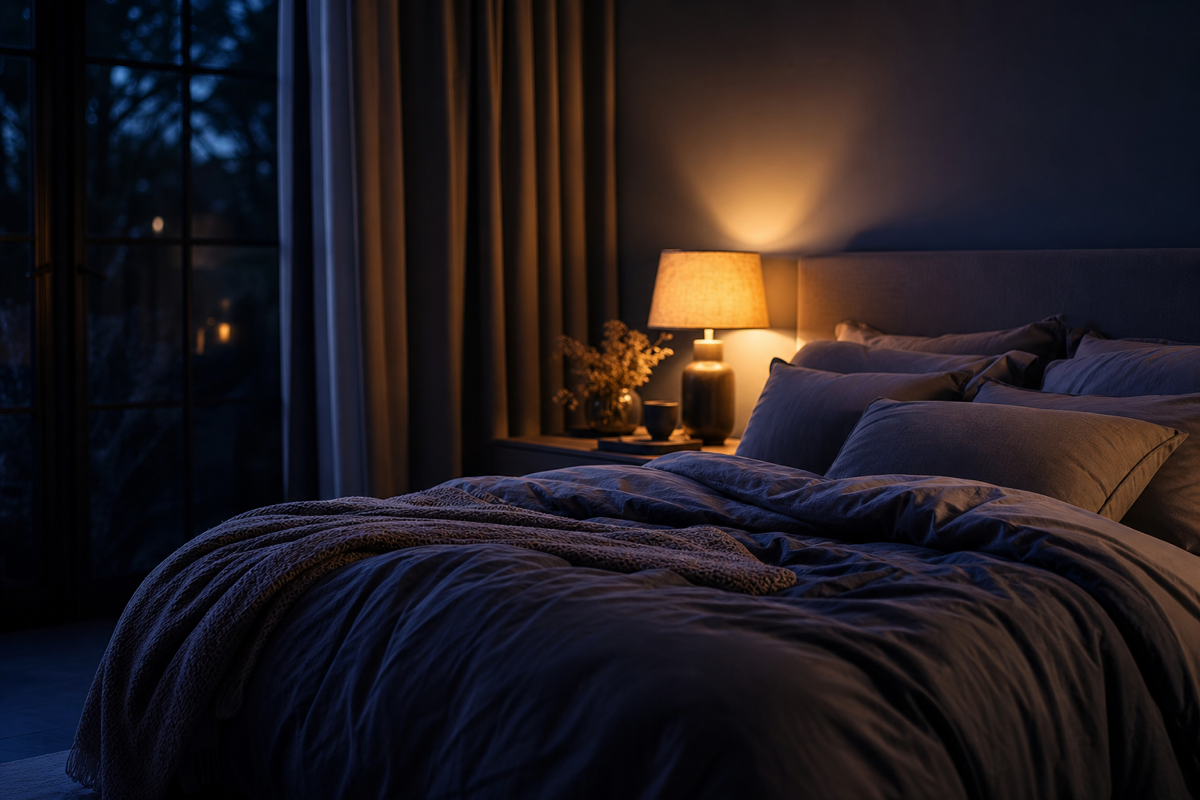
- A red or amber night-light is the right call for night wakings, kids’ rooms and 3 a.m. bathroom trips because it least disturbs melatonin.
- Total darkness still beats every colored light for actual sleeping — colored light is for the wind-down and the wake-ups, not for all night.
Your eyes contain a set of cells that have nothing to do with seeing. They are there to answer one question for your body clock — is it daytime? — and they answer it by detecting light, with a strong preference for blue-cyan wavelengths around 480 nm. Every lighting decision in your evening either respects that system or fights it. That is the entire science of "what color light for sleep," and it makes the answers refreshingly concrete.
The ranking, worst to best
Worst: cool white / blue-white. Daylight-spectrum LEDs, phone and TV screens, bright bathroom lighting — all rich in exactly the wavelengths melanopsin watches for. Evening exposure delays melatonin release and pushes the body clock later; the brighter and closer, the stronger the effect.
Middle: warm white (2700 K and below). The standard "soft white" bulb is genuinely gentler — much less blue content — and is fine for early evening at moderate brightness.
Best: amber and red. These sit at the far end of the spectrum, where melanopsin barely responds. A dim red or amber light is the closest artificial light gets to invisible-to-the-clock — which is why it is the standard advice for night-lights and pre-bed reading lamps. (To be precise about the popular claim: red light doesn't make you sleepy — it simply fails to wake your clock up, which after sunset is the whole victory.)
Better than all of them: darkness. For actual sleeping, no colored bulb beats a genuinely dark room. Colored light is a tool for the wind-down and the wake-ups — not something to bathe in until dawn.
Brightness multiplies everything
Color is only half the dose; intensity is the other half. A dim cool light can suppress melatonin as much as a brighter warm one, and a very bright "warm" bulb still carries enough blue to matter. The rule that survives the research: after sunset, go warm and dim together — the lowest light that still lets you do the thing you're doing. Lamps below eye level beat ceiling fixtures for the same reason: less light reaches the upward-facing detectors.
Red light bulbs: worth it?
For three uses, clearly yes. The 3 a.m. bathroom trip: a red night-light in the hallway or bathroom lets you navigate without slamming your clock with a white-light pulse that can leave you wired for an hour. Kids’ rooms: children’s eyes transmit more light and their clocks are more sensitive — a dim red or amber night-light is the sleep-safe answer to fear of the dark. The last hour of reading: an amber bulb in the bedside lamp keeps the wind-down from doubling as a light therapy session. Skip the expensive "sleep spectrum" marketing — any dim red/amber bulb from the hardware store does the same photobiology.
Your evening light plan
2 hours out: ceiling lights off, warm lamps on. 1 hour out: screens down or night-mode + low brightness (better: none — night modes help but don't neutralise brightness and engagement). Swap the visual feed for an audio one: this is exactly the slot where a steady, quiet soundtrack earns its keep, occupying attention with zero light — our deep sleep playlist below is made for the lights-low hour. In bed: darkness, or the dimmest amber if you read; eye mask if the room can't go dark. Morning: the flip side — get bright, ideally outdoor, light within an hour of waking. The clock is set by contrast: dim evenings and bright mornings, and each makes the other work better. (Struggling to drop off even in good light? The full protocol is in how to fall asleep fast.)
FAQ
Is red or amber light better for sleep?
Functionally equivalent — both sit where the clock barely responds. Amber tends to be more pleasant to actually use (red can feel odd for reading); pick by comfort and keep it dim.
Do blue light glasses work?
Amber-tinted blockers worn in the evening can meaningfully cut melanopsin stimulation; clear "computer glasses" cut very little. They are a patch — dimming the room and ending screens earlier does more, with the glasses as backup for unavoidable late screen work.
What color night light is best for a child afraid of the dark?
A dim red or amber night-light, placed low and away from the bed. It provides reassurance while leaving melatonin — theirs and yours — largely undisturbed. Cool white or blue night-lights are the one clearly wrong answer.