Relaxing Sleep Music: What to Play All Night (and Why It Works)
Relaxing sleep music is the steady floor under a full night's rest. This guide explains what to play, how loud, all-night playback done right, and how it differs from a wind-down playlist.


- All-night relaxing music works mainly through sound masking: it smooths over the noises that cause micro-wakings.
- The ideal overnight soundscape is warm, slow, seamless and boring — designed to be felt, not listened to.
- Keep overnight volume at the lowest level that still masks disturbances, typically 40-50 dB.
- Seamless, long-form playlists beat shuffled songs: transitions and surprises fragment light sleep.
- 432 Hz-tuned instrumentals are a popular overnight choice for their warm, soft character.
Relaxing sleep music is a different tool from a wind-down playlist: it is the steady floor that runs under your entire night. Done right, you stop noticing it within minutes — and it keeps working for hours, smoothing over the door-slams, pipe-clicks and passing cars that would otherwise pull you toward waking. Here is how to choose it and play it well.
How all-night music actually helps
During light sleep stages your brain still monitors sound. Sudden noises against silence trigger micro-arousals — brief wakings you rarely remember but pay for in the morning. A continuous soft soundscape raises the acoustic floor, so those spikes stop standing out. This is the same masking principle behind white noise, delivered with more warmth.
What to play: the overnight profile
The perfect overnight track is gloriously boring: very slow, low-contrast, warm-toned, with long evolving textures instead of melodies that ask for attention. No lyrics, no crescendos, no shuffle-surprises. Our Deep Sleep Music playlist is sequenced for exactly this — hours of seamless 432 Hz-tuned warmth engineered to disappear into the background of your night. For the science of that tuning, see what 432 Hz does to the brain.
All-night playback, done right
“The best relaxing sleep music is music you stop noticing — and keep feeling.”
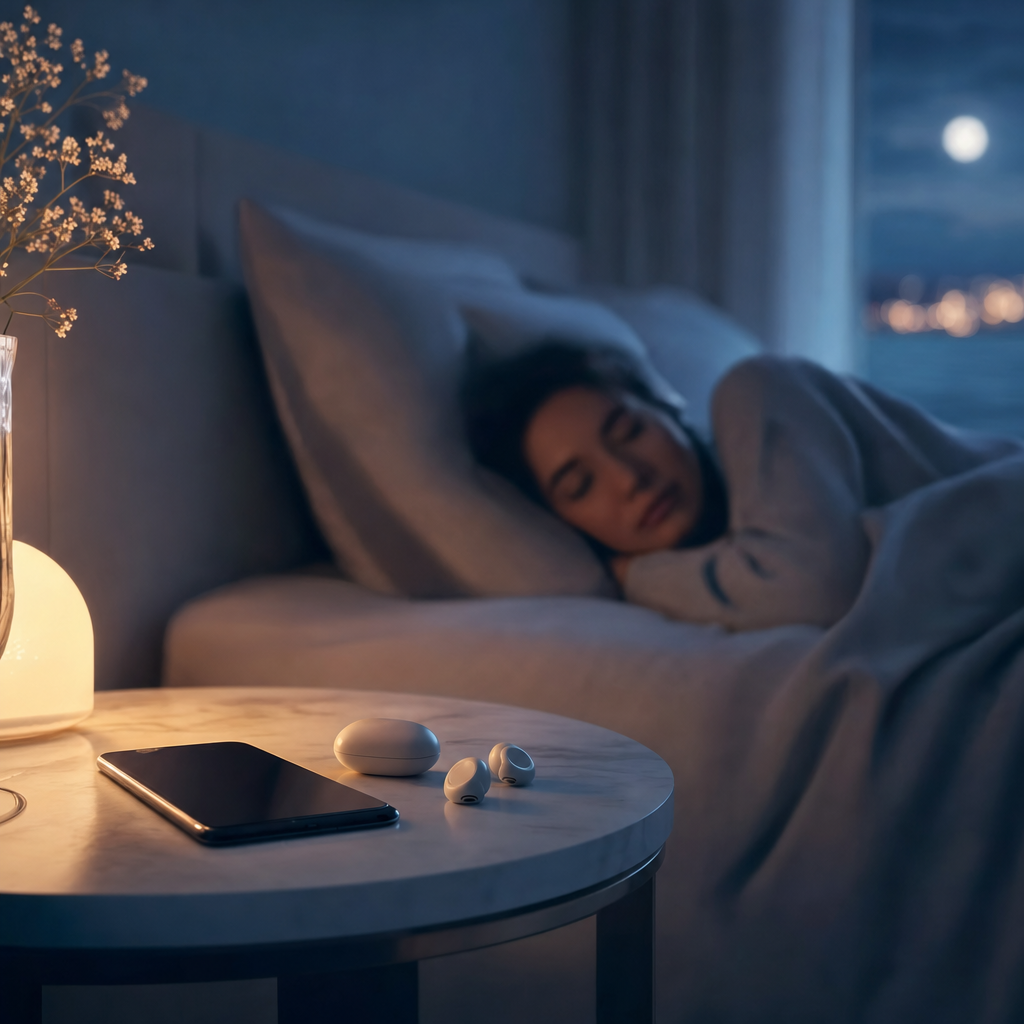
Three practical rules: volume — the lowest level that still covers your typical disturbances (usually 40-50 dB; you should be able to whisper over it); source — a speaker across the room, not earbuds, which can hurt ears and sleep posture; continuity — a long seamless playlist or loop, so there is no jolt at 3 a.m. when an album ends. If you prefer not to run audio all night, a 60-90 minute fade-out timer covers the descent through your first deep-sleep cycle.
Relaxing music vs. calming music
If your problem is a racing mind before bed, start with calming music for sleep — the active wind-down. Relaxing sleep music takes over where that ends: passive, steady, all night. Many people use both as a single sequence.
Frequently asked questions
Is it bad to sleep with music on all night?
No — at safe, low volume from a speaker it is harmless for adults and genuinely helpful in noisy environments. Avoid earbuds overnight.
What is the best genre of relaxing sleep music?
Texture beats genre: slow ambient instrumentals, soft piano soundscapes and warm drones all work when they are seamless and lyric-free.
Music, white noise or rain — which is best overnight?
All three mask noise. Music adds warmth and emotional comfort; rain and noise are more neutral. Try our rain sounds guide and pick what your mornings vote for.